
World Fine Art Professionals and their Key-Pieces, 527 - Ward Bos

ward bos 1
World Fine Art Professionals and their Key-Pieces, 527 – Ward Bos
In the windows of the GP’s practice Bonaire (Huisartsenpraktijk) in the Baarsjesbuurt in Amsterdam, paintings by Ward Bos can be seen. And inside, in the waiting room, there is also work by him. I recently went to have a look. A great variety: from landscapes, a game of chess to Catalan ceramics, and more.
Ward Bos and his wife currently live partly in a renovated farmhouse in Sweden. Ward occasionally comes over to the Netherlands. I spoke to him in the café of Hotel Krasnapolsky in Amsterdam.

ward bos 2
From Amsterdam to Sweden
Their farm is on the edge of a Swedish village, Ward says. “I can walk for hours in a hilly area of forests and fields. I see more rabbits there than people.”
When the financial crisis hit in 2008, he was still living and working in Amsterdam. He made many murals on commission. When those commissions decreased, Ward decided to close his studio in Amsterdam and move to Sweden. There he could quietly work on his paintings.

ward bos 3
Group of cows
It can take quite some time before he puts an idea in his head on canvas. “Sometimes I brood over it for years. An idea comes, becomes clearer, and then I put it to a halt in my head. It has to develop further while painting. With painting you respond to what emerges under your hands.”
On one of those walks he saw a group of cows on top of a hill. He made two smaller painted studies of them in his studio. Painted from below with a huge part of the sky. These preliminary studies serve to later make several large paintings with this subject.

ward bos 4
Wine jars
A psychotherapist commissioned him to make a painting for behind her desk, where the people she treats look at them. He painted a small study of two rows of wine jars in different sizes. In his studio, he blew up the small study into a large painting. On the left and right, the jars are only partially depicted, as if they were a fragment of many more jars. The openings of the jars are depicted as flat stripes, not as ovals that you can look into from below or from above. Together, these stripes form a rhythm within the composition of the painting. The jars themselves are round. Each jar is different and has its own personality, so to speak.
“Often one painting flows from the other; number four of the paintings with the jars is in the starting blocks.”

ward bos 5
Chess Game
Another painting hanging in GP’s practice was a painting of a chess game. “My father was crazy about chess. I followed that and stored it in my memory. In 1972, Spassky defended his world title against the American chess genius Bobby Fischer. In 1956, when Fischer was 13 years old, he played a sensational game against the grandmaster Donald Byrne in which he sacrificed his queen. The final position of that game is brilliant. This game went down in history as ‘the Game of the Century’.”
The final position of this game would be the subject of a tribute to Bobby Fischer. After having replayed the game four times and having looked at the final position on the board from all sides, Ward chose a square canvas and pulled the board, on the canvas, out of his perspective. Only the hands of the two chess players are visible. One of Fischer’s child’s hands points to the final position, the other hand rests with its fingertips on the edge of the table. A gesture of: ‘There, I’ve got you’. Byrne’s hands seem to say: ‘You’ve got me mat, I am defeated’.
Here and there are colored parts of ochre and sienna in the foreground, against a background of a gray part. In the painting he reverses those parts. Gray parts come to the foreground and the warm colors go to the background. This reinforces the dualism of the chess game in the painting.

ward bos 6
Themes
Ward uses a number of themes. For example, he makes tributes to people who fascinate him. He calls them ‘My Heroes’. For example, a painting of Columbus, Piranesi, Bobby Fischer, Marinus van der Lubbe. He had already read about the latter, the Dutchman who set fire to the Reichstag in 1933, in his youth in the books of Dr. L. de Jong. Later he read more about him and came across a photo of Marinus’ cap that had been found at the bottom of the stairs of the Reichstag. Under the photo was the text: ‘Mütze des Täters’, and is the title of the tribute to Marinus van der Lubbe. Ward is currently working on a painting about Abebe Bikila, who won the marathon barefoot at the 1960 Olympic Games.
He also makes still lifes about food. He paints series of three works each about his hobby of cooking: The first painting is about the groceries, the second about dinner and the third about the dishes. Another theme is landscapes. He gets his ideas on his walks in the nature of Sweden. He paints them in his studio. His butterfly paintings – also on display in the doctor’s office – are a reference to his youth. When he had a teacher at school who showed him a cabinet with stuffed butterflies, the desire arose to own such a butterfly cabinet himself one day. Years later he came up with the idea of painting them from his imagination.

ward bos 7
Murals
He still occasionally makes murals in both the Netherlands and Sweden. Every space is different and all owners are different. “In a short conversation I try to sense what they want. Sometimes you can change a space with a painting of one bird in the right place. I came into a large hall with a heavy old support beam on the ceiling. When you entered the hall, the beam immediately attracted all the attention. Next to the beam I painted a chicken in the colours of that beam, with the diameter of the chicken and the beam being the same. The attention was now better divided and the hall was visually more balanced. Another time I was in a space that was dominated by a small white radiator with a large thermostat knob. The client asked if I could paint the radiator in the colours of the wall. I had a better idea to make the radiator less noticeable. On the piece of wall between the door and the radiator I painted a large white rooster, 56 cm high, the same height as the radiator knob, as if they were looking at each other. This gave the radiator a different status.”
Another time he came across a bathroom with lots of black and white and chrome. “I had a better idea than to brighten up the space with trompe l’oeil windows: I painted a group of penguins right in the corner, which made the corner disappear and created an effect that the penguins turn with you as you walk through the space while looking at the corner.”

ward bos 8
Can Ward name a key work?
He doesn’t have a key work. “I get a new idea every time. Often one painting flows from another.”

ward bos 9
How long has he been an artist?
“When I was 15, I started taking drawing lessons with the artist Ton Albers. He smelled talent and intensified the lessons. After a year or two of learning a lot, I wanted to apply for admission to the Rietveld Academy. There I heard that I had to go to the Rijksacademie, the Valhalla of art education. That was in 1976. Because they thought I was very young, I went to the evening course for the first year: five evenings a week and on Mondays and Fridays during the day for perspective drawing and anatomy. The following year I was able to go to the preparatory course and so I continued. After a year of preparatory course, there were two basic years and three professional years of monumental painting. I learned an incredible amount, also through study trips. I was young and passionate. It was great. After a few years, I got my own studio in the Academy building and in later years my own studio outside the building. Due to the reorganization of the Rijksacademie, I was able to take over the studio where I worked for the last year. I lived and worked there for 30 years, until I moved my studio to Sweden.”

ward bos 10
Finally, what is his artistic philosophy?
“In Sweden I renovated our farm for two years. The studio and workshop were the first to be renovated, then the house. Because I did and still do everything myself, I was hardly able to paint for a few years. In recent years I have been painting full-time again, but I have sometimes wondered ‘Is my passion disappearing?’ And if it did not return, would I mind? If they put me in the Sahara, what would I do? Search for water and shade? Or make drawings in the sand with my finger, the chalk that never runs out and the paper that never ends?” He feels a certain non-committal attitude towards the art world. “Do I have anything to add to painting? I don’t think so, I do it because I can’t help it. There is a Dutch proverb: ‘Bloed kruipt waar het niet gaan kan’ (a person cannot hide his true nature), Innate tendencies will always surface.”
See also the video: https://www.youtube.com/watch?v=upyf01Kj3CA
Images
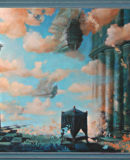
1)Columbus’ dream, 140x110cm, 2) Butterflies 1, 3) Four seasons no.1 180x130cm, 4) Game of the century, Hommage to Bobby Fischer 95x95cm, 5) Hens, 6) I and Ella, 7) Mutze des Tater, Hommage to Marinus van der Lubbe 145x115cm, 8) pinguins in the corner of a bathroom 2, 9) Piranesi’s dream 140x110cm, 10) Pottery no.1 165x125cm
https://www.wardbos.com/
https://mlbgalerie.nl/
https://inzaken.eu/

Disclaimer: The views, opinions and positions expressed within this guest article are those of the author Walter van Teeffelen alone and do not represent those of the Marbella Marbella website. The accuracy, completeness and validity of any statements made within this article are not guaranteed. We accept no liability for any errors, omissions or representations. The copyright of this content belongs to Walter van Teeffelen and any liability with regards to infringement of intellectual property rights remains with the author.



The opinions expressed by individual commentators and contributors do not necessarily constitute this website's position on the particular topic.