
World Fine Art Professionals and their Key-Pieces, 526 - Patricia Werneck Ribas Revisited

Patricia Werneck Ribas Balburdia – 1
World Fine Art Professionals and their Key-Pieces, 526 – Patricia Werneck Ribas Revisited
In Balbúrdia, Patricia Werneck Ribas explores the imagery surrounding Dutch colonialism in Brazil through collage and film. I speak with her in Gallery WM about the exhibition.
Patricia: “A mythology has developed around Dutch colonialism in North-East Brazil in the 17th century, especially in Brazil, but also in the Netherlands. With this exhibition I deconstruct those images.”

Patricia Werneck Ribas Balburdia – 2
Maurits to Brazil
Many Dutch people seem to know nothing about this period, she says. But in Brazil it is part of history and geography lessons at secondary school. The Netherlands was in North-East Brazil for 30 years, from 1624 to 1654 and Maurits van Nassau (in full Johan Maurits van Nassau-Siegen) for 8 years, from 1636 to 1644.
In October 1636, Maurits leaves Texel with 2,600 men on twelve ships for Brazil. He takes scientists and artists with him to study plants, animals and population. Once there, he defeats the small Portuguese army and expands the territory of the colony.

Patricia Werneck Ribas Balburdia – 3
He has the city of Recife walled and builds a new city attached to it: Mauritsstad, with the residence Vrijburg in it. He has roads, bridges and canals built and to get the sugar production going, he has abandoned plantations auctioned and lends money to buyers. He meets the need for labor by conquering Fort Elmina on the African west coast to import slaves from there.
Maurits’ personal physician Willem Piso (1611-1678) conducted groundbreaking research into medicines and tropical diseases. The German naturalist, geographer, cartographer and mathematician Georg Marcgraf (1610-1644) researched the weather, flora and fauna and mapped the country. Piso and Marcgraf wrote the Historia Naturalis Brasiliae together, which would remain the standard work on Brazil until the nineteenth century.

Patricia Werneck Ribas Balburdia – 4
Frans Post and Albert Eckhout
The first botanical garden on the continent is created around Vrijburg, the first systematic astronomical observations are made in observatories and the first zoo is built in Recife. In the meantime, the young painters Frans Post (1612-1680) and Albert Eckhout (circa 1607-circa 1665) capture the country on canvas. Eckhout captured the Tupinambá, the original Indian inhabitants of the area, and Post painted the landscape.

Patricia Werneck Ribas Balburdia – 5
Patricia: “Maurits did good things for the city of Recife and its surroundings. He laid out streets and gardens, built palaces and a fortress (Itamaracá). It became much more beautiful and above all more European. When the Dutch period in Brazil came to an end after 30 years, the area started to look more like it did before. The works of art also disappeared in part; some of the paintings ended up in the Dutch Mauritshuis, but most of them ended up in Denmark, his mother was the Queen of Denmark. In 2019, the Mauritshuis had an exhibition about Brazil and slavery.

Patricia Werneck Ribas Balburdia – 6
“Our high school teacher said that to properly assess the Dutch period in Brazil, we also had to look at Suriname and the Dutch East Indies, where the Dutch had also been present. You had to identify not only with the colonizer, he said, but also with the colonized.”

Patricia Werneck Ribas Balburdia – 7
How do people in Brazil look back on this time?
For her project, she wanted to see whether students in high schools in Brazil still think about it, but also people her age in and around Recife. “I started a study on Facebook. What would Brazil have become if the Netherlands had stayed there? People said: ‘it would look like Suriname or Aruba’. People with more knowledge also said that it might have become worse because the Dutch were more racist than the Portuguese. And besides, the Dutch were concerned about the sugar. They mainly thought about the money they could earn.”
“Others said: if the Dutch had stayed it would look like Holambra.” Holambra is a Brazilian municipality in the state of São Paulo, founded on October 27, 1991. Its name, a contraction of Holland, America and Brazil, comes from the Dutch settlement that was established on the former Ribeirão farm. The municipality, full of windmills, 17th century Dutch houses and flower fields, is the largest production center of flowers and plants in Latin America. Holambra is considered a tourist attraction and annually hosts the largest flower exhibition in Latin America: the Expoflora.

Patricia Werneck Ribas Balburdia – 8
“Few said that if the Dutch had stayed, we would now be as rich as the Dutch. In texts I found that some Brazilians were in favor of a Dutch stay because they were whiter than the Portuguese, they would have made the country whiter. Because of corona, most young people had far fewer lessons and almost no lessons in history and geography. They often had no opinion. They did not know whether the Dutch were in Brazil in the 17th, 18th, or 19th century. Very sad.”

Patricia Werneck Ribas Balburdia – 9
Film and collages
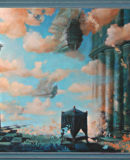
“I decided to make a deconstruction. With film (in 2023) and collages (in 2024). A rebellious, playful way to dissect imagination. I made something new in an abstract way. With pieces of painting, drawings and my photos in that area, photos from an image bank about Brazil and pieces of painting that I painted myself. The collages are named after an animal or fruit from that area. For example, as fruit species umbu and uxi and as animal species cockatoos, quatis and preas.”
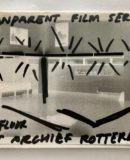
In the film, ‘Para M.’, a film of 11.46 minutes, you hear a woman talking to Maurits. And you see women from the area, all the people in the film are women. There are recordings in the mangrove forests, in the Hortus Botanicus on the beach and in the city. She also used drones for the recordings. You see professional dancers dancing a deconstructed frevo dance, with nuances of the gabber dance.
“A very strong image that has a lot of influence on the film is Eckhout’s painting ‘Mulher Negra’. Zacharia Wagner was also one of the painters who was there, he painted the same woman, now with Maurits’ brand (an M) above her left breast. You don’t see that brand with Eckhout. I was thinking about that woman. She was sold to the government. The truth is slowly coming out.”

Patricia Werneck Ribas Balburdia – 10
Where does the name Balbúrdia come from?
“It is Portuguese for noise, chaos or disorder. It encapsulates the refusal to present a finished or reconciling historical narrative. Instead, the exhibition offers a dynamic, disruptive space where past and present collide and dominant narratives are broken open.”
From July 11 to November 30, 2025, Patricia’s work can be seen in the exhibition ‘Refresh Amsterdam #3: Imagine the Future’ at the Amsterdam Museum aan de Amstel. This exhibition is part of the celebration of 750 years of Amsterdam.
Images
1)Para M 1, 2) Quati, 3) Calango, 4) Boto, 5) self-portrait, 6) Mariposa, 7) Tamanduá, 8) Anta, 9) Mandacaru, 10) Umbú
http://www.patriciawerneckribas.com/
https://gallerywm.com/WP/patricia-wener-ribas-09-05-07-06-2025/
https://www.instagram.com/patriciawerneckribas/
https://www.facebook.com/patricia.ribas001/
https://inzaken.eu/

Disclaimer: The views, opinions and positions expressed within this guest article are those of the author Walter van Teeffelen alone and do not represent those of the Marbella Marbella website. The accuracy, completeness and validity of any statements made within this article are not guaranteed. We accept no liability for any errors, omissions or representations. The copyright of this content belongs to Walter van Teeffelen and any liability with regards to infringement of intellectual property rights remains with the author.




The opinions expressed by individual commentators and contributors do not necessarily constitute this website's position on the particular topic.